
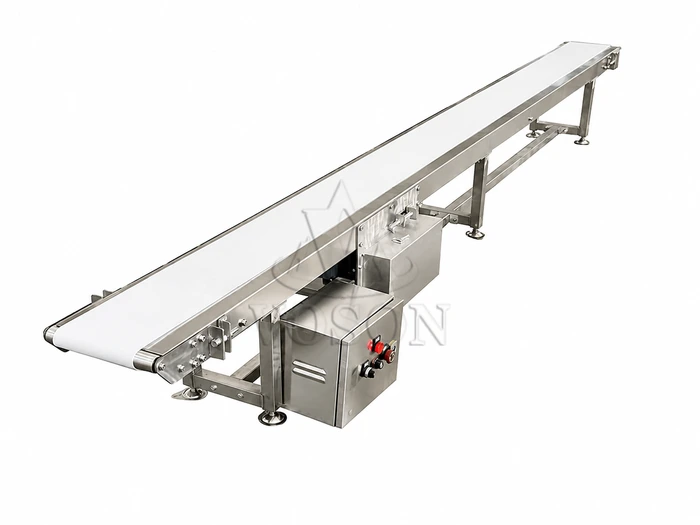
Stainless Steel Belt Conveyor
Capacity: Customized; confirmed from product, belt loading and conveying layout
Voson stainless steel belt conveyors provide hygienic horizontal or inclined transfer of grains, granules, food ingredients and packaged products.
The Voson Stainless Steel Belt Conveyor provides continuous horizontal or inclined transfer of grains, granules, food ingredients, bags and packaged products. Its stainless steel frame, accessible conveying surface and configurable belt make it suitable for connecting processing, inspection, weighing and packing equipment.
Unlike screw or scraper conveyors, a belt supports the product across the complete conveying surface. This helps reduce unnecessary impact and makes the machine especially useful for fragile granules, finished packages and production stages where operators need to observe the product.
Product Overview
| Item | Available Configuration |
|---|---|
| Suitable products | Grain, seeds, granules, food ingredients, bags, cartons and assessed bulk materials |
| Installation | Horizontal or inclined |
| Frame | Stainless steel structure; grade and construction scope confirmed per project |
| Belt | Smooth, cleated, sidewall or other application-selected belt |
| Belt width and length | Customized for product size, capacity and plant layout |
| Drive | Fixed-speed or variable-speed motor and gearbox |
| Available options | Side guides, feed hopper, cover, supports, sensors and collection tray |
Capacity and motor power are selected for the actual product and layout. Belt width, loading depth, conveying distance, incline and operating speed all affect final performance.
Main Features
- Clean stainless steel structure: Suitable for food, grain and ingredient processing environments when the agreed materials meet the project requirements.
- Gentle product transfer: The continuous belt surface helps limit impact and product breakage.
- Horizontal or inclined conveying: The frame, belt and supports can match different inlet and outlet elevations.
- Multiple belt options: Smooth, cleated or sidewall belts can be selected for loose materials or packaged products.
- Accessible design: The belt, guides and return section can be arranged for easier inspection and cleaning.
- Adjustable operating speed: Variable-frequency control can coordinate the conveyor with inspection, weighing or packing equipment.
- Customized connections: Feed hoppers, discharge transitions and side guides can match upstream and downstream machines.
Typical Applications
The stainless steel belt conveyor can be used for:
- Transferring cleaned grain, seeds or food granules between machines.
- Feeding suitable products into weighing and packaging equipment.
- Carrying bags, sacks, cartons or finished packages after packing.
- Moving products through manual inspection or sorting positions.
- Connecting a low-level discharge with moderately elevated equipment.
- Serving food-processing lines where an accessible conveying surface is preferred.
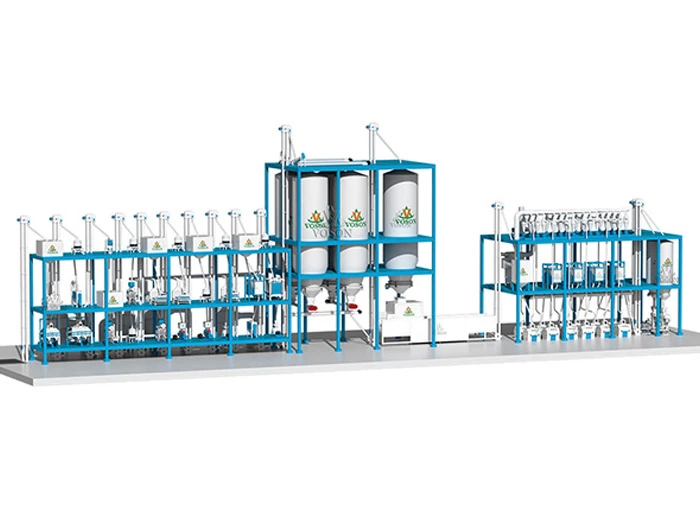
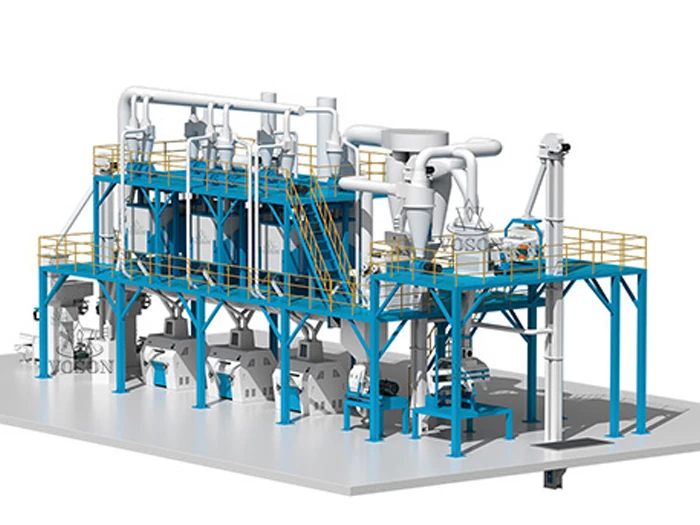
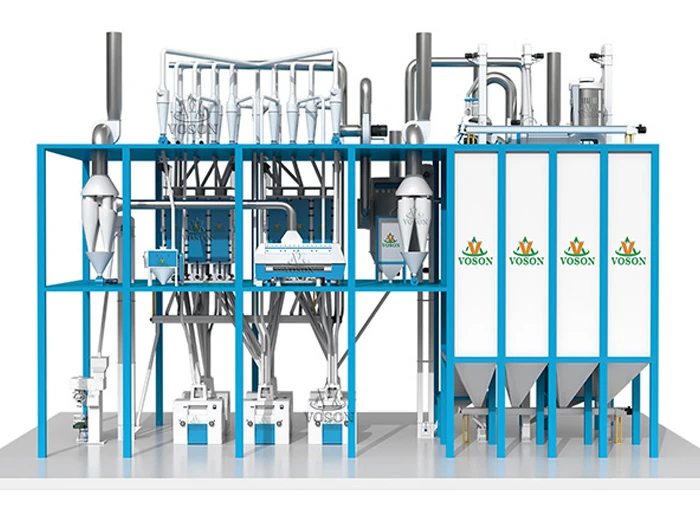
In a wheat flour milling plant, the conveyor may be installed in grain handling, ingredient preparation or finished-package sections. Fine flour requires additional dust-control assessment because an open belt is not naturally sealed.
Available Belt Conveyor Designs
Horizontal Belt Conveyor
The horizontal design connects equipment at similar elevations. It is suitable for stable loose products, bags and cartons and can include adjustable side guides or inspection positions.
Inclined Belt Conveyor
An inclined conveyor raises material to a hopper, grader or packing machine. The workable angle depends on the product's friction, stability and tendency to roll or slide.
Cleated Belt Conveyor
Transverse cleats help retain granules or packages on an incline. Cleat height and spacing are selected according to product dimensions, feed rate and conveying angle.
Sidewall Belt Conveyor
Raised sidewalls help contain loose material along the belt edges. Sidewall height and the feeding transition are designed to reduce spillage without trapping excessive residue.
Covered Belt Conveyor
A removable cover can protect the conveying route and improve dust control. Covers, however, do not replace proper inlet sealing or dust extraction when handling very light powders.
Food-Contact and Hygiene Considerations
The stainless steel frame and light-coloured belt shown in the product image are commonly used in food-processing equipment. However, belt colour alone does not prove that a conveyor is certified for food contact.
Where food-contact compliance is required, Voson confirms the belt compound, supporting documentation, stainless steel grade, surface finish and product-contact construction in the quotation. Cleaning chemicals, operating temperature, oil exposure and allergen-control requirements should also be provided before the belt is selected.
An accessible layout can include removable collection trays, belt scrapers, open-frame sections or quick-release components. The appropriate design depends on the product residue and the plant's cleaning procedure.
How the Belt Conveyor Works
An endless belt runs around the drive and tail pulleys. Supporting rollers or a sliding bed carry the loaded belt, while the motor and gearbox drive the head pulley. Product enters through a controlled feed area, travels with the belt and discharges into the next machine or collection point.
Correct alignment, tension and centred loading help maintain stable tracking. Off-centre feeding or sudden material surges can push the belt sideways and cause spillage. The upstream feed rate should therefore match the usable belt width and conveying speed.
Optional sensors can monitor belt motion, product presence or downstream accumulation. Emergency stops and guards are arranged according to the equipment layout and operating requirements.
Belt Conveyor vs Air Cushion Belt Conveyor
This product is different from the existing air cushion belt conveyor.
| Selection Point | Stainless Steel Belt Conveyor | Air Cushion Belt Conveyor |
|---|---|---|
| Belt support | Rollers or a sliding support | Air film beneath the loaded belt |
| Typical duty | Equipment-to-equipment and processing-line transfer | Longer-distance, higher-volume bulk grain conveying |
| Common products | Food ingredients, granules and packaged products | Bulk grain and similar materials |
| Main design priority | Cleanability, belt type and machine connections | Route length, airflow, capacity and running resistance |
The stainless steel model is intended for flexible processing-line duties. The air-cushion design is normally considered for larger bulk-handling routes where reduced belt resistance over distance is important.
Choosing the Right Conveyor Type
| Process Requirement | Recommended Conveyor to Evaluate |
|---|---|
| Visible, gentle transfer or package handling | Stainless steel belt conveyor |
| Short enclosed flour or powder transfer | Stainless steel screw conveyor |
| Complex enclosed route with several direction changes | Stainless steel tubular chain conveyor |
| Direct vertical lifting | Stainless steel bucket elevator |
The final choice should consider product properties, dust containment, distance, elevation, cleaning access and available floor space rather than equipment name alone.
Reference Selection Parameters
Confirmed universal model, capacity and motor-power values are not available for this product. The following table shows the basis used for project selection.
| Parameter | Selection Basis |
|---|---|
| Belt width | Product size, loading depth and required throughput |
| Conveyor length | Distance between feeding and receiving equipment |
| Belt speed | Capacity, product stability and inspection requirements |
| Incline | Product friction, cleats and side containment |
| Motor power | Loaded resistance, conveyor length, incline, speed and operating duty |
| Belt specification | Food-contact requirements, temperature, oil exposure and cleaning method |
| Supports | Equipment elevation, floor conditions and maintenance clearance |
| Control options | Speed adjustment, sensors, interlocks and emergency stops |
Final dimensions, belt specification and drive power are confirmed after the material information and layout drawing have been reviewed.
Frequently Asked Questions
Is the white conveyor belt automatically food-grade?
No. Colour does not confirm compliance. The belt material and supplier documentation must meet the food-contact requirement specified for the project.
Can this conveyor transport finished flour?
It requires a dust-control assessment. A cover, side skirts and extraction may be needed, while an enclosed screw or tubular conveyor may be more appropriate for some fine-flour duties.
Can the conveyor operate on an incline?
Yes. The allowable angle depends on product friction, particle shape, cleat design, sidewalls and required capacity.
Can the belt speed be adjusted?
Variable-frequency control is available. The usable speed range is selected to maintain capacity, stable tracking and coordination with connected machines.
Is the complete machine manufactured from stainless steel?
The quotation defines the construction scope. The frame and product-area components can be stainless steel, while the motor, gearbox, bearings and selected accessories may use different materials.
What information is required for selection?
Provide the product or package size, capacity, conveyor length, inlet and outlet heights, incline, cleaning method, required belt certification, local voltage and connected equipment.
Contact Voson with your product information and plant layout to receive a stainless steel belt conveyor configuration for your food, grain or packaging line.
GET IN TOUCH NOW !
YOUR PRIVACY IS IMPORTANT TO US AND YOUR INFORMATION WILL BE WELL PROTECTED!