
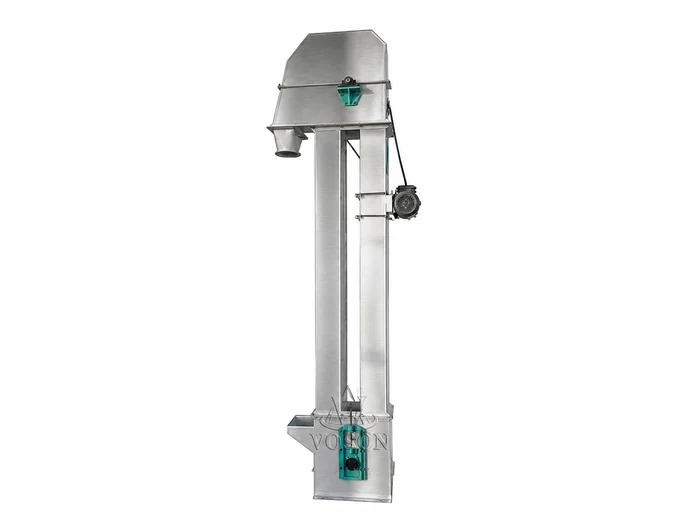
Stainless Steel Bucket Elevator
Capacity: Customized; confirmed from material data and lifting height
Voson stainless steel bucket elevators provide enclosed vertical lifting of grain, bran and suitable bulk products in flour milling and processing plants.
A flour mill often needs to raise material several metres while using as little floor area as possible. The Voson Stainless Steel Bucket Elevator creates a direct vertical connection between receiving, cleaning, storage and processing levels. It can be engineered for wheat, maize, rice, bran, grits and other compatible free-flowing bulk products.
Material travels inside buckets mounted on a moving belt or chain. The casing surrounds the conveying path, helping the plant manage dust and keep the lifted product separated from the general factory environment. Voson designs the inlet height, discharge elevation, casing modules, drive and support arrangement around the customer's building and process flow.
Quick Configuration Guide
| Project Question | Available Solution |
|---|---|
| What can be lifted? | Wheat, maize, rice, bran, grits and assessed dry bulk products |
| Where does the material travel? | From a lower feed point to an upper discharge point |
| What carries the product? | Application-selected buckets on a belt or chain |
| Which parts can be stainless steel? | Product-contact casing and buckets, or a wider specified construction scope |
| How is the height determined? | From the actual inlet, outlet and equipment-connection elevations |
| How is the machine controlled? | Stand-alone starter or interlocked line control with optional monitoring |
| Can connection details be changed? | Yes; inlet, outlet, supports and transition pieces are project-specific |
This is a configured machine, not a standard elevator with one capacity for every flour plant. Throughput can only be confirmed after reviewing the product, bulk density, particle range, moisture, lifting height and operating schedule.
Where It Fits in a Flour Mill
The elevator is most useful when the next process is located directly above the previous one. For example, it can connect a receiving conveyor to raw-grain bins or transfer cleaned wheat to an upper distribution level. A compact vertical line can reduce the need for a long inclined conveyor and leave more floor space for process equipment and maintenance access.
Common duties include:
- Raising incoming grain from a pit or horizontal conveyor to storage.
- Supplying cleaned grain to conditioning or tempering bins.
- Feeding an upper-floor distributor serving several process lines.
- Moving bran or suitable coarse by-products to a collection bin.
- Elevating grits or other assessed granular products after grading.
- Supplying a buffer bin above weighing or packing equipment.
For a wheat flour milling plant, the elevator should be included in the process layout at an early stage. This allows inlet direction, discharge orientation, structural supports and service platforms to be coordinated with the building rather than adjusted after equipment manufacture.
Material Flow from Boot to Discharge
Product enters the lower boot through a controlled feed connection. Moving buckets collect the incoming material and travel upward through the enclosed casing. At the top, the belt passes around a pulley, or the chain moves around a sprocket, allowing the buckets to empty through the head outlet.
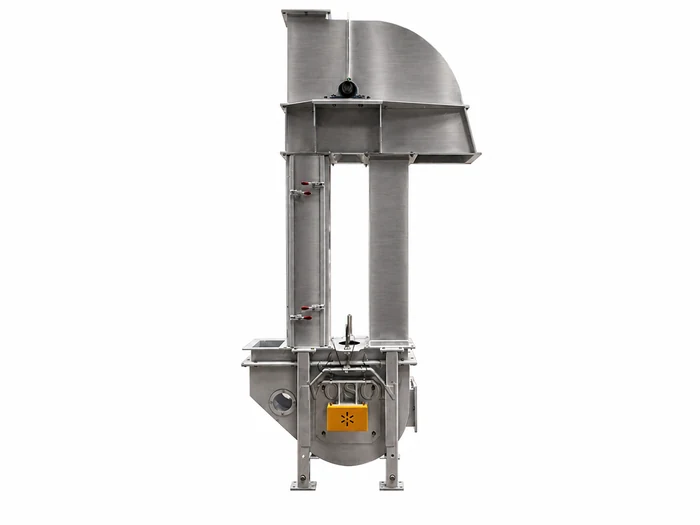
The boot must receive a consistent feed. If the upstream conveyor supplies more product than the buckets can remove, the lower section can flood and operating resistance increases. For that reason, the feeding device, elevator and downstream bin are normally connected through a coordinated start-stop sequence.
Correct discharge also matters. Bucket profile, travel speed and head geometry must suit the product so that it leaves the bucket and enters the outlet instead of returning down the casing. These details are selected as one system rather than as separate components.
Construction Choices
Belt or Chain Arrangement
A belt can suit many grain-handling duties and offers a continuous support for the bucket set. A chain arrangement may be selected where the load, operating conditions or project specification make it more appropriate. Voson confirms the conveying member after reviewing the duty rather than treating the two arrangements as interchangeable.
Bucket Selection
Bucket volume and spacing influence the amount of product moved during each cycle. Shape also affects pickup, retention and discharge. Product particle size, breakage sensitivity, density and flow behavior therefore need to be considered before the bucket specification is fixed.
Modular Casing and Access
Vertical casing sections are joined to reach the required elevation. Inspection doors can be positioned near components that require routine checking, while cleanout access can be arranged around the boot. The number and position of openings should support the plant's maintenance plan without weakening dust containment.
Drive, Tension and Protection
The head-mounted drive moves the loaded bucket system. A tensioning mechanism in the lower section maintains suitable belt or chain condition. Optional speed sensing, misalignment detection, blockage alarms and level signals can stop feeding or shut down the line when an abnormal condition is detected.
Benefits of a Stainless Steel Contact Path
- Stainless steel product-contact surfaces provide corrosion resistance for compatible materials and cleaning practices.
- Enclosed lifting helps reduce airborne dust and material loss around the conveying route.
- A vertical configuration makes efficient use of space in multi-storey mill buildings.
- Customized transitions reduce unnecessary on-site modification between connected machines.
- Inspection and cleanout points can be positioned according to the maintenance procedure.
- Monitoring devices and electrical interlocks can be incorporated into central plant control.
“Stainless steel bucket elevator” does not automatically mean every external component is stainless steel. The quotation should state the alloy grade, surface treatment and exact construction boundary. Motors, gearboxes, bearings, platforms and structural supports can have different material requirements from the product-contact parts.
Materials That Need Additional Review
Free-flowing grain and coarse products are generally easier to evaluate than fine, sticky or wet materials. Finished flour may adhere to buckets and casing surfaces, create dust-sealing demands and require more frequent cleaning. A stainless steel screw conveyor can be a better option for some short flour-transfer routes.
Fragile products also need attention because high pickup or discharge speeds may increase breakage. Abrasive particles can affect bucket, casing and conveying-member life. Voson therefore asks for material data before confirming whether a standard vertical bucket route is appropriate.
Choosing Between Straight and Z-Type Lifting
The selection starts with the route, not simply with the equipment name.
| Plant Requirement | Straight Bucket Elevator | Z-Type Bucket Elevator |
|---|---|---|
| Primary movement | Direct vertical elevation | Horizontal collection followed by vertical lifting and horizontal discharge |
| Space requirement | Small floor footprint | More room at the lower and upper sections |
| Best layout fit | Feed and discharge points are vertically aligned | Feed and discharge points are offset |
| Typical handling priority | Efficient continuous elevation | Flexible route and potentially gentler granular transfer |
| Main engineering inputs | Lift, throughput, bucket system and head discharge | Complete route, product protection, bucket speed and outlet position |
Use a straight elevator when the lower and upper connections can be aligned and floor space is limited. Consider a Z-type machine when the production route needs horizontal sections or when the discharge point is offset. The final decision should be made after comparing building dimensions, material behavior and cleaning access.
Project-Based Selection Data
The table below explains the information used for engineering selection. It is not a list of guaranteed standard specifications because confirmed universal model, capacity, lifting-height and motor-power data were not supplied for this product.
| Engineering Item | How It Is Determined |
|---|---|
| Elevator model | Selected after process duty and layout review |
| Required output | Customer throughput adjusted for product density and filling behavior |
| Drive rating | Calculated from lift, loaded bucket system, resistance and service duty |
| Overall height | Derived from feed level, outlet level, headroom and connection transitions |
| Bucket set | Chosen from particle size, density, flowability and product protection needs |
| Belt or chain | Matched to load, operating environment and maintenance requirements |
| Casing supports | Located according to height, building structure and service access |
| Automation | Defined by upstream/downstream interlocks and requested monitoring devices |
Any value discussed before the layout and product data are reviewed remains preliminary. Final dimensions and motor power are stated in the project quotation and drawing.
Information Needed for a Proposal
Please provide:
- Product name and a short description of its condition.
- Required hourly throughput.
- Bulk density and particle-size range, when available.
- Moisture level and any tendency to stick or bridge.
- Vertical distance between feed and discharge connections.
- Preferred inlet and outlet directions.
- Upstream and downstream machine details.
- Available headroom, support locations and maintenance space.
- Required stainless steel scope, local voltage and control expectations.
With this information, Voson can prepare the general arrangement and select the bucket system, casing, tensioning device, drive, transitions and monitoring options for the line.
Frequently Asked Questions
Can the elevator connect directly to existing equipment?
Yes, when the existing inlet and outlet elevations, flange sizes, orientation and available support points are supplied. A site drawing is particularly useful for retrofit projects.
Does stainless steel construction improve hygiene?
Stainless steel provides a corrosion-resistant contact surface, but hygienic performance also depends on access, residue control, welding and finishing quality, cleaning procedure and surrounding plant design.
Can one machine lift both grain and flour?
The same general equipment type may be considered, but grain and flour behave differently. Finished flour requires separate evaluation for filling, discharge, dust sealing and residue. Do not assume a configuration selected for wheat kernels will perform identically with flour.
What prevents overfilling at the boot?
The upstream feed rate must match the elevator capacity. Level or blockage monitoring and electrical interlocks can stop the feeder when abnormal accumulation is detected.
Is a service platform included?
Platforms, ladders and structural supports are project items. Their scope should be confirmed from the building arrangement, local access requirements and customer responsibility boundary.
Why is there no fixed motor-power table?
Drive demand changes with lifting height, throughput, material density, bucket system, resistance and operating duty. Publishing one motor value without those inputs could lead to incorrect selection.
Send Voson the material data, required throughput and plant elevation drawing to receive a stainless steel bucket elevator proposal matched to the flour mill process.
GET IN TOUCH NOW !
YOUR PRIVACY IS IMPORTANT TO US AND YOUR INFORMATION WILL BE WELL PROTECTED!