
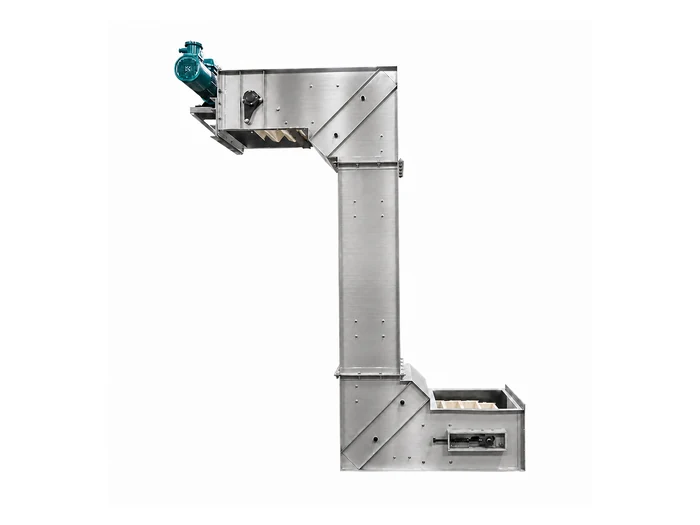
Stainless Steel Z-Type Bucket Elevator
Capacity: Customized; confirmed from product data and conveying route
Voson stainless steel Z-type bucket elevators provide enclosed, layout-flexible lifting of grains, granules and suitable ingredients in flour plants.
The Voson Stainless Steel Z-Type Bucket Elevator combines a lower horizontal section, a vertical lifting section and an upper horizontal discharge section in one enclosed route. This layout lets a flour or food-processing plant collect material at a convenient low level, pass around adjacent equipment and deliver it to an elevated bin, weigher or packing system.
The machine is primarily considered for free-flowing grains, seeds, granules and other compatible ingredients that benefit from controlled bucket handling. Its route, bucket speed, inlet design and discharge arrangement are engineered for the product and site rather than selected from a single universal configuration.
At-a-Glance Configuration
| Design Item | Project Option |
|---|---|
| Conveying path | Lower horizontal feed, vertical elevation and upper horizontal discharge |
| Suitable products | Evaluated grains, seeds, granules, pellets and dry ingredients |
| Conveying carrier | Overlapping or separated buckets selected for product behavior |
| Contact construction | Stainless steel scope and grade stated in the project specification |
| Feed and discharge | One or more positions subject to route and control design |
| Cleaning access | Inspection doors, removable covers and cleanout sections as required |
| Line coordination | Sensors, variable-speed control and upstream/downstream interlocks |
Capacity cannot be confirmed from the machine name alone. Bucket volume, spacing and travel speed must be considered together with bulk density, particle size, fragility, feeding consistency, lift and outlet arrangement.
Why Choose a Z-Shaped Route?
A straight elevator works well when the lower and upper connections are vertically aligned. Many production rooms, however, contain bins, mixers, weighing equipment, columns or access aisles that prevent a direct connection. The Z-shaped path introduces horizontal sections so the inlet and outlet can be offset.
This can simplify three common layout problems:
- Receiving product at floor level while keeping the drive and outlet above the packing line.
- Moving around an existing machine or structural obstruction before lifting.
- Feeding an elevated destination that is not positioned directly over the inlet.
The route should be planned with the complete process drawing. Horizontal lengths, vertical height, bend geometry, support positions and maintenance clearance all affect the final equipment arrangement.
Product Movement Through the Elevator
Material enters the lower feed section at a controlled rate. Buckets receive the product and travel horizontally toward the vertical casing. They then rise through the enclosed column and continue along the upper section before discharging at the selected outlet.
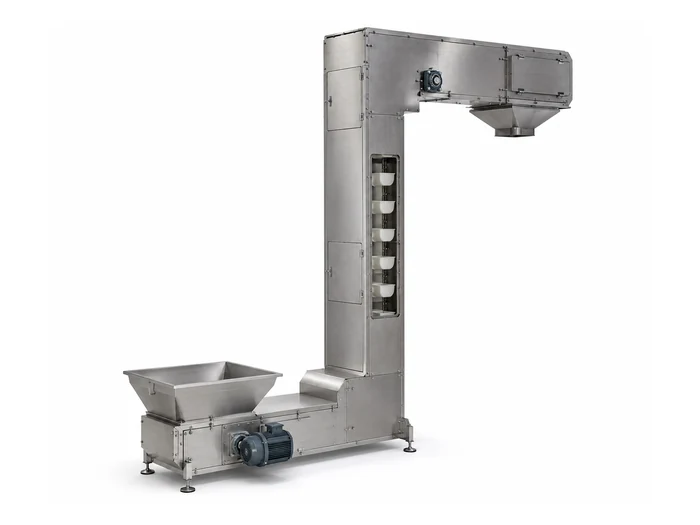
Bucket loading must be steady enough to avoid overfilling, spillage or unused bucket volume. At the top, the discharge mechanism and bucket movement are matched to the product so that material leaves the carrier cleanly and enters the downstream chute or machine.
The conveying route normally operates as part of an interlocked system. If the receiving bin is full or the downstream weigher stops, the elevator and upstream feeder should respond in the correct sequence instead of continuing to load the casing.
Equipment Sections and Engineering Choices
Lower Feeding Section
The lower section establishes how material enters the bucket stream. Hopper shape, feeder type and inlet position must prevent sudden surges. A small controlled feeder may be required when the upstream process cannot provide an even flow.
Vertical Column
The vertical casing contains the main lifting distance. Its section joints, supports and inspection points are planned around the required elevation and building structure. Adequate clearance is needed for installation and future servicing.
Upper Discharge Section
The upper horizontal run brings material to the receiving bin or processing machine. Outlet position, direction and transition geometry are customized to reduce unnecessary drops and connect neatly with the next stage.
Buckets and Conveying Member
Bucket shape, volume, overlap and spacing affect retention, residue and product protection. The supporting chain or other conveying member is selected for the loaded route and operating duty. These components must be treated as a coordinated set.
Drive and Control
The drive moves the complete loaded bucket circuit. Optional speed sensing, overload protection, blockage detection, level signals and variable-frequency control can be integrated with the plant's electrical system.
Suitable Duties in Flour and Ingredient Plants
The Z-type elevator is not limited to one position in a production line. It may be evaluated for:
- Supplying grains or seeds to an elevated cleaning or grading machine.
- Lifting coarse ingredients to a batching or blending system.
- Feeding granular additives into an upper storage hopper.
- Connecting a low-level discharge to a multihead weigher.
- Delivering compatible products to an automatic packing line.
- Routing material around equipment where a straight lift cannot be installed.
For flour mill projects, this machine is more commonly associated with granular or coarse products than with finished fine flour. Flour can create dust, residue and discharge challenges; its suitability must be reviewed separately. A stainless steel screw conveyor may be a simpler option for a short enclosed powder transfer.
Product Protection and Cleaning Considerations
Gentle handling depends on more than using buckets. Feeding speed, fill level, direction changes, bucket geometry, travel speed and discharge drop all influence product damage. Fragile seeds or granules should be evaluated using the complete conveying cycle.
Cleaning requirements also vary. Plants that change products frequently may need removable panels, accessible buckets, cleanout openings and reduced residue points. The customer should identify allergen-control or cross-contamination requirements before the design is finalized.
Stainless steel contact parts provide a corrosion-resistant surface for compatible products and procedures. They do not by themselves certify the machine for a particular hygiene standard. Weld finishing, access, component design and the customer's cleaning method remain important.
Z-Type Elevator Compared with Other Conveyors
| Process Need | Z-Type Bucket Elevator | Straight Bucket Elevator | Screw Conveyor |
|---|---|---|---|
| Route | Offset inlet and outlet with horizontal and vertical travel | Direct vertical travel | Straight horizontal or inclined travel |
| Best use | Layout-sensitive lifting of compatible granules | Compact elevation between aligned points | Short enclosed transfer or controlled feeding |
| Product carrier | Individual buckets | Individual buckets | Rotating screw flight |
| Space requirement | Requires lower and upper horizontal space | Small floor footprint | Requires length along the conveying direction |
| Main design concern | Entire route, bucket loading and gentle discharge | Lift, bucket system and head discharge | Screw diameter, pitch, speed and angle |
Choose the Z-type arrangement when route flexibility or a controlled bucket path is central to the project. Choose a straight stainless steel bucket elevator when the two connections can be vertically aligned. The final selection should follow the process layout and material assessment.
Reference Engineering Inputs
No confirmed universal model, output or motor-power table was supplied for this equipment. The entries below describe how a project configuration is developed; they are not guaranteed specifications.
| Input | Engineering Use |
|---|---|
| Product and bulk density | Determines bucket filling and load through the route |
| Particle size and fragility | Influences bucket shape, speed and discharge handling |
| Required throughput | Establishes bucket volume, spacing and operating speed |
| Lower and upper horizontal lengths | Defines the offset and equipment footprint |
| Vertical elevation | Establishes column length and lifting duty |
| Feed and outlet positions | Determines hopper, chute and transition geometry |
| Cleaning procedure | Guides access panels, removable parts and residue control |
| Electrical sequence | Defines sensors, alarms, interlocks and speed control |
Motor rating and final dimensions are confirmed only after these inputs and the installation drawing have been reviewed.
Information to Send Voson
For a proposal, provide:
- Product name, photos or a sample description.
- Required hourly capacity and operating hours.
- Bulk density, particle range, moisture and fragility.
- Lower feeding height and upper discharge height.
- Horizontal offset between inlet and destination.
- Number and preferred position of feed and discharge points.
- Upstream feeder and downstream equipment information.
- Available floor area, headroom and support locations.
- Cleaning expectations and stainless steel construction scope.
- Local electrical supply and desired control signals.
Voson can then prepare a route drawing and select the buckets, conveying member, casing, drive, inlet, outlet and controls for the actual line.
Frequently Asked Questions
Is a Z-type bucket elevator suitable for finished flour?
It requires a separate assessment. Fine flour may create dust, adhesion and residue issues, so another enclosed conveying method can be preferable. The decision depends on the route and cleaning requirements.
Can the inlet and outlet be positioned farther apart?
Yes, within an engineered layout. The lower and upper horizontal lengths can be configured to create an offset, but supports, total load and maintenance access must also be considered.
Does the elevator reduce product breakage?
Bucket handling can support gentle transfer, but breakage depends on feed impact, fill level, speed, bends and discharge drop. Product data or testing may be necessary for fragile materials.
Can several outlets be added?
Multiple discharge positions may be possible depending on the bucket circuit and discharge mechanism. Their operation and sealing must be defined during design.
Which components are stainless steel?
The quotation states the construction boundary. Product-contact buckets and casing can be stainless steel, while the drive, guards, supports and other non-contact items may use a different material unless otherwise specified.
Why are capacity and motor power shown as customized?
Both depend on the complete route, product load, bucket system, lift and operating speed. A fixed number without those inputs would not be reliable.
Send Voson the product details and a layout showing the feed and discharge points to receive a stainless steel Z-type bucket elevator configuration for your flour or ingredient plant.
GET IN TOUCH NOW !
YOUR PRIVACY IS IMPORTANT TO US AND YOUR INFORMATION WILL BE WELL PROTECTED!