
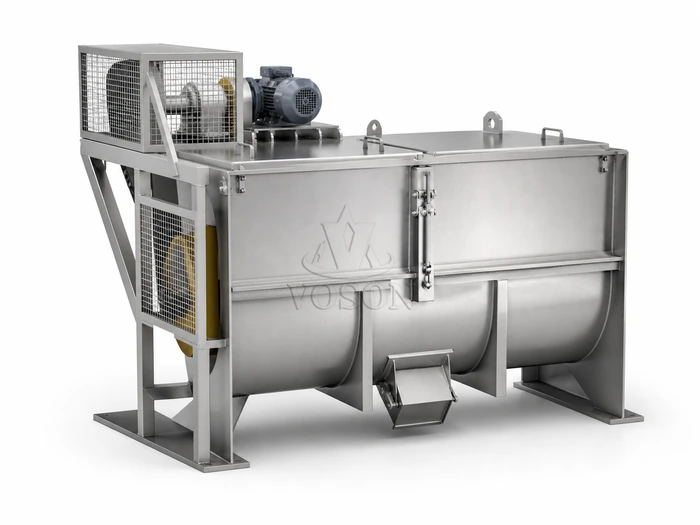
Stainless Steel Ribbon Mixer
Capacity: Customized; confirmed from recipe, bulk density and batch volume
Voson stainless steel ribbon mixers blend flour, starch, premixes and dry ingredients in configurable batches for flour milling and ingredient plants.
The Voson Stainless Steel Ribbon Mixer prepares repeatable batches of flour, starch, premixes and other compatible dry ingredients. A horizontal U-shaped chamber contains helical ribbon elements that circulate material across the vessel, helping ingredients with different addition rates become distributed throughout the batch.
Voson configures the working volume, drive, inlet arrangement, discharge and access points from the customer's recipe and production schedule. The mixer can operate as an independent batch machine or as part of a coordinated flour blending, dosing and packing system.
Mixer Configuration at a Glance
| Process Item | Project Configuration |
|---|---|
| Typical batch materials | Flour, starch, premixes and assessed free-flowing dry ingredients |
| Mixing action | Horizontal circulation created by inner and outer ribbon flights |
| Batch size | Selected from working volume, bulk density and required batch weight |
| Contact construction | Stainless steel grade and scope defined in the quotation |
| Feeding | Manual, bag-dump, screw-fed or connected to weighed ingredient bins |
| Discharge | Bottom outlet adapted to the downstream conveyor, bin or packing system |
| Controls | Timed batch sequence with optional variable speed and interlocks |
There is no meaningful universal capacity or mixing-time figure for every recipe. A machine that handles a light premix may have a different usable batch weight from one handling dense starch, even when the chamber volume is identical.
How Ribbon Mixing Creates Circulation
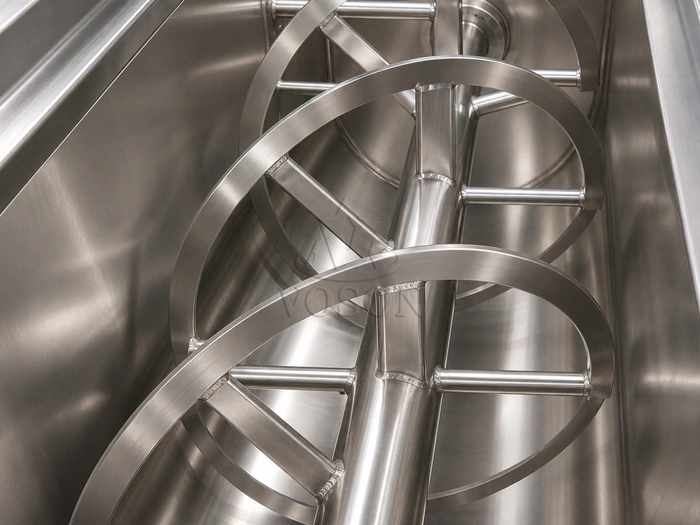
The mixing shaft carries inner and outer helical flights. As the shaft rotates, the ribbons move material in opposing axial directions while also lifting and folding it across the vessel. This combined motion continually changes the position of ingredients within the batch.
The mixer is normally loaded to a defined working range. Too little product may not engage the intended circulation pattern, while excessive filling can reduce movement and increase drive load. Ribbon clearance, shaft speed, vessel geometry and recipe properties must therefore be considered together.
The goal is not simply to run the machine for as long as possible. A validated mixing time should produce the required distribution without unnecessary energy use, excessive temperature rise or ingredient damage.
Building a Reliable Batch Sequence
Mixing performance starts before the shaft turns. Ingredient accuracy, addition order and feeding position can strongly affect the final result.
A typical automated sequence may include:
- Confirm that the discharge valve is closed and the mixer is ready.
- Add the main flour or carrier ingredient through a weighed feed system.
- Introduce minor ingredients at the selected time and location.
- Run the mixer for the recipe-specific period and speed.
- Open the bottom discharge after the receiving equipment is ready.
- Confirm vessel emptying before the next batch begins.
Liquid addition is not assumed. If oil, water or another liquid must be sprayed into the batch, its viscosity, dosage, nozzle arrangement and effect on residue require separate engineering review.
Integration in a Flour Blending Line
The ribbon mixer can connect several production stages:
- Flour storage or collection bins above the feeding system.
- Major-ingredient weighing equipment.
- Micro-ingredient dosing or manual addition stations.
- Dust-controlled bag-dump points.
- A buffer hopper below the mixer.
- An enclosed conveyor feeding packaging equipment.
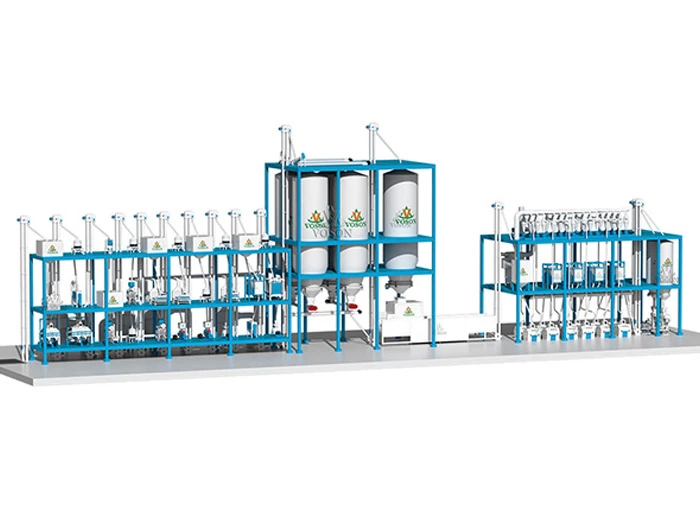
In a wheat flour milling plant, the blending section may be used to standardize flour, prepare customer-specific formulations or incorporate approved dry ingredients. Equipment elevations and batch timing should be planned so the mixer is not waiting for upstream weighing or blocked by a full downstream hopper.
A stainless steel screw conveyor can transfer powder into or away from the mixer where a short enclosed route is suitable. Conveyor output must match the batch sequence to avoid overfeeding or long idle periods.
Construction and Access Options
Mixing Chamber
The U-shaped vessel supports the ribbon circulation pattern. Wall thickness, reinforcement, cover arrangement and outlet geometry are selected for the batch size and operating load.
Ribbon and Shaft Assembly
Ribbon pitch, diameter, supporting arms and clearances influence circulation and residue. The shaft and bearings are designed for the expected load, while the product-contact construction is stated separately from non-contact components.
Top Cover and Feeding Ports
The cover can include one or more feed connections, inspection openings and access doors. Guards and electrical safety switches may be added according to the operating method and local requirements.
Bottom Discharge
Outlet size and valve type affect discharge time and retained material. The transition should connect cleanly with a receiving hopper or conveyor and allow safe access for maintenance.
Drive and Control Panel
Motor and gearbox selection considers batch load, ribbon geometry and start-up conditions. Controls can manage mixing time, discharge sequence, variable speed, alarms and interlocks with surrounding equipment.
Hygiene and Product-Change Planning
Stainless steel offers a corrosion-resistant contact surface for compatible ingredients and cleaning methods. Hygienic performance, however, also depends on weld finishing, ribbon-to-wall clearances, outlet geometry, seals and operator access.
Plants producing several formulations should identify acceptable carryover before choosing the cleaning arrangement. Dry brushing, vacuum cleaning, access-panel cleaning or another validated method may be used depending on the product. Frequent allergen changes can require a more demanding design than continuous production of one flour blend.
“Stainless steel mixer” does not automatically mean the motor, gearbox, frame, guards and every external part use stainless steel. The material grade, surface finish and construction boundary must be written into the project specification.
Factors That Influence Blend Uniformity
| Process Factor | Why It Matters |
|---|---|
| Batch weight and fill level | Determines whether the material engages the designed circulation zone |
| Bulk-density difference | Can influence movement and segregation tendency |
| Particle-size distribution | Affects how ingredients disperse and settle |
| Addition order | Determines when minor ingredients enter the circulating mass |
| Mixing duration | Must be long enough for distribution but not unnecessarily extended |
| Shaft speed | Influences circulation, power demand and product handling |
| Discharge behavior | Affects batch separation and residual material |
| Sampling method | Determines whether blend-quality results are representative |
Uniformity should be evaluated using the customer's real formulation and an agreed sampling method. Visual appearance alone is not a reliable validation for ingredients used at a low inclusion rate.
Ribbon Mixer or Twin-Shaft Paddle Mixer?
| Selection Question | Ribbon Mixer | Twin-Shaft Paddle Mixer |
|---|---|---|
| Main mixing element | Inner and outer helical ribbons | Paddles mounted on two counter-working shafts |
| Typical circulation | Axial and radial movement through the vessel | Broad three-dimensional movement and lifting |
| Common project priority | General dry-powder batch blending | Faster batch cycles or rapid discharge, subject to recipe testing |
| Vessel arrangement | Horizontal U-shaped chamber | Horizontal chamber with twin shaft system |
| Selection basis | Recipe, fill level, mixing target and discharge need | Recipe, cycle time, product handling and discharge need |
Neither design is automatically better for every flour formula. The correct choice depends on ingredient properties, batch size, required uniformity, cycle time, cleaning procedure and investment scope.
Reference Selection Information
Confirmed fixed models, capacities and motor powers were not supplied for this mixer. The following items describe the engineering inputs used to select a machine; they are not guaranteed standard specifications.
| Required Input | Selection Use |
|---|---|
| Recipe and ingredient list | Establishes material compatibility and mixing duty |
| Batch weight | Sets the required usable working volume |
| Bulk density | Converts batch weight into occupied chamber volume |
| Minor-ingredient ratio | Helps plan addition and validation requirements |
| Desired batches per hour | Defines the available time for feeding, mixing and discharge |
| Upstream weighing method | Determines feed ports and control interfaces |
| Downstream process | Determines outlet, valve and discharge coordination |
| Cleaning procedure | Guides access, finish and residue-control choices |
Final chamber volume, motor rating and batch cycle are confirmed after Voson reviews these details and, where necessary, conducts a material test.
Information Required for a Proposal
Please provide:
- Ingredient names and approximate formulation percentages.
- Required batch weight and batches per hour.
- Bulk density and moisture of the main ingredients.
- Information about fragile, sticky or very fine components.
- Existing weighing and feeding equipment.
- Required inlet and outlet elevations.
- Desired discharge time and downstream equipment capacity.
- Cleaning frequency and product-change procedure.
- Stainless steel grade, surface finish and construction scope.
- Local voltage and desired automation level.
Voson can then prepare the mixer arrangement and select the chamber, ribbon system, drive, feeding ports, discharge valve, supports and controls for the flour blending line.
Frequently Asked Questions
Can the mixer blend small additions into a large flour batch?
It can be evaluated for that duty, but addition accuracy and feeding position are critical. A premix step may be recommended for very low inclusion ratios, and uniformity should be validated by representative sampling.
How long does one mixing cycle take?
Cycle time includes feeding, actual mixing and discharge. It varies with recipe, batch size, required uniformity and connected equipment, so it should not be specified from mixer volume alone.
Can liquids be added?
Possible liquid addition must be reviewed separately. Dosage, spray pattern, viscosity, cleaning and the effect on powder flow all influence the design.
Is the complete mixer manufactured from stainless steel?
Only the scope stated in the quotation is included. Product-contact parts may be stainless steel while drive and support components use another material unless full stainless construction is requested.
How is cross-contamination reduced?
Appropriate access, smooth finished surfaces, reduced residue zones and a validated cleaning procedure help control carryover. The required standard depends on the recipes and product-change frequency.
What determines motor power?
Batch load, material behavior, ribbon geometry, shaft speed and start-up condition all affect drive demand. Motor power is confirmed from the selected mixer and duty.
Send Voson your formulation, batch target and plant layout to receive a stainless steel ribbon mixer proposal for the flour blending process.
GET IN TOUCH NOW !
YOUR PRIVACY IS IMPORTANT TO US AND YOUR INFORMATION WILL BE WELL PROTECTED!