
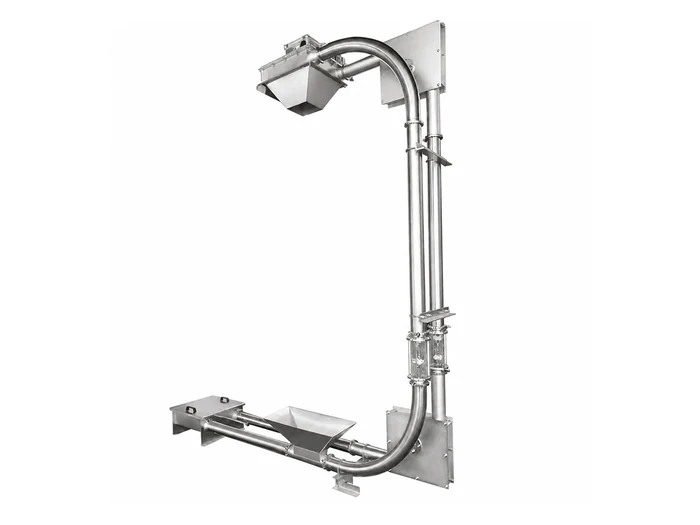
Stainless Steel Tubular Chain Conveyor
Capacity: Customized; confirmed from material data and the complete conveying route
Voson stainless steel tubular chain conveyors route flour, starch and dry ingredients through enclosed pipes with flexible horizontal and vertical layouts.
The Voson Stainless Steel Tubular Chain Conveyor moves flour, starch, premixed powders and other assessed dry materials through an enclosed pipe circuit. Discs fixed at intervals along a continuous chain carry the product at controlled speed, allowing one conveyor to combine horizontal, inclined and vertical sections where the plant layout requires a change in direction.
This route flexibility is valuable in flour and ingredient plants where bins, mixers, dosing equipment and packing machines are distributed across different elevations or rooms. Instead of installing several separate conveyors at each turn, a correctly engineered tubular system can form one contained transfer path.
Configuration Summary
| Project Item | Available Arrangement |
|---|---|
| Typical products | Flour, starch, premixes and compatible dry powders or granules |
| Route | Horizontal, inclined and vertical sections in one planned circuit |
| Conveying element | Continuous chain with product-moving discs inside a pipe |
| Contact construction | Specified stainless steel grade and product-contact scope |
| Inlets and outlets | Quantity and position coordinated with process equipment |
| Drive and tension | Selected for circuit length, number of bends and material load |
| Controls | Fixed or variable speed with optional level, motion and blockage signals |
No single capacity or motor rating applies to every tubular chain system. Pipe diameter, disc spacing, chain speed, circuit length, number of bends, elevation change and material behavior must be assessed together.
Solving Complex Plant Routes
Conveying flour through an existing factory is often a routing problem before it is a machine-selection problem. A direct line may be blocked by structural columns, working platforms or other process equipment. Transfer points between several conventional conveyors can add dust-control, cleaning and maintenance work.
A tubular chain conveyor can be configured to:
- Receive material below a bin and turn toward a separate production area.
- Rise to an upper-floor mixer or buffer hopper.
- Cross a service aisle while keeping the product inside the pipe.
- Deliver to more than one planned outlet along the circuit.
- Return the empty chain through a contained route to the drive section.
The route is not unlimited. Every bend, vertical section and additional metre changes resistance and chain loading. Voson reviews the complete path before selecting the pipe, discs, chain, drive and tensioning arrangement.
How the Chain-and-Disc System Moves Product
Material enters the conveying pipe through a controlled inlet. As the chain travels, its discs create moving chambers that push or pull the material along the pipe. The product follows the selected route until it reaches an open outlet or an actuated discharge point.
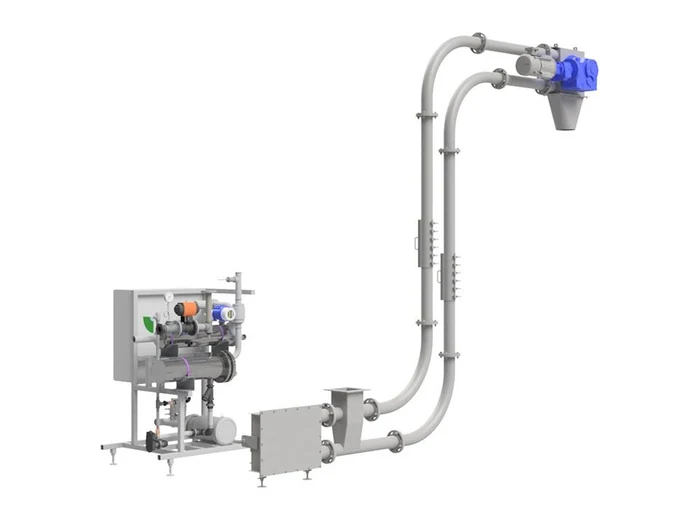
Because movement occurs inside a closed pipe, the number of exposed transfer locations can be reduced. Controlled chain speed can also provide a lower-velocity alternative to some pneumatic systems, subject to the actual material and throughput requirement.
The upstream feeder must match the available carrying volume. Uncontrolled surges can overfill the pipe, raise chain tension and cause unstable operation. The conveyor is therefore normally interlocked with bin outlets, feeders and downstream level controls.
Main Design Sections
Drive Station
The drive moves the loaded chain through the complete circuit. Gearbox and motor selection reflects the total route, product load, vertical lift and bend resistance. Drive location is chosen with access and chain loading in mind.
Conveying Pipes and Bends
Pipe sections form the enclosed product channel. Bend radius and orientation must let the discs pass smoothly without creating unnecessary resistance. Flanged or otherwise engineered joints allow the route to be assembled and accessed in sections.
Chain and Discs
The chain carries tensile load, while the discs move material and separate the internal volume into conveying spaces. Disc material, diameter and spacing are selected for particle size, temperature, abrasion, product compatibility and cleaning needs.
Tensioning and Return Circuit
Suitable chain tension supports stable engagement and prevents excessive slack. The return path is part of the same circuit and must be included in layout, support and access planning.
Feeding, Discharge and Inspection
Inlet devices regulate loading into the pipe. Discharge valves or open outlets direct product to the required destination. Inspection points are positioned where operators need to check internal components or perform cleaning and maintenance.
Applications in Flour and Dry-Ingredient Processing
Possible duties include:
- Transfer from a finished-flour bin to a blending system.
- Conveying starch or premixed ingredients between rooms.
- Feeding an elevated batching or micro-ingredient hopper.
- Moving bran or compatible by-products to storage.
- Connecting a mixer discharge to weighing or packing equipment.
- Serving several planned receiving points along one engineered route.
In a wheat flour milling plant, pipe routing should be coordinated with aspiration ducts, pneumatic lines, electrical trays, building access and sanitation zones. Early coordination reduces field changes and helps preserve maintenance clearance.
Not every powder behaves well in a tubular chain conveyor. Highly sticky material may build up on discs or pipe walls. Very abrasive product can shorten component life, and easily compacted powder may increase resistance. Material evaluation is required before confirming the conveying method.
Containment, Residue and Cleaning
An enclosed pipe helps limit dust escape during normal transfer, but system hygiene depends on the complete design. Inlet and outlet seals, joints, inspection access and downstream transitions must all support the plant's containment target.
Residual product can remain around discs, bends and discharge points. Plants with frequent formula changes or allergen-control requirements should state their acceptable carryover and cleaning procedure. Possible measures include accessible sections, cleanout ports, removable components or a route designed to reduce difficult retention areas.
Stainless steel contact construction provides corrosion resistance for compatible products and wash or dry-cleaning methods. It does not by itself make the system sanitary. Surface finish, weld treatment, gasket selection and access must also match the customer's standard.
Comparing Enclosed Conveying Options
| Selection Factor | Tubular Chain Conveyor | Screw Conveyor | Pneumatic Conveyor |
|---|---|---|---|
| Route flexibility | Can combine several directions and elevations | Best for a comparatively straight route | Pipes can follow complex paths |
| Product movement | Chain-mounted discs at controlled speed | Rotating screw flight | Air stream at higher velocity |
| Transfer points | One circuit can reduce intermediate transfers | Separate units may be needed at route changes | Usually one pipeline with air-separation equipment |
| Main concern | Chain load, bends, residue and access | Screw wear, filling, angle and cleaning | Air volume, filtration, energy and product behavior |
| Typical project fit | Enclosed mechanical route through a complex layout | Short feeding or transfer duty | Longer or highly flexible powder movement where pneumatic handling is suitable |
A stainless steel screw conveyor is often simpler for a short straight connection. Pneumatic conveying may suit routes where an air-based system is acceptable. The tubular chain option becomes attractive when the plant needs mechanical conveying through several direction changes with fewer intermediate machines.
Reference Project Inputs
Confirmed standard model, capacity and motor-power figures were not supplied for this product. The table explains the information used to prepare a project-specific configuration rather than presenting fixed performance claims.
| Required Input | Effect on Selection |
|---|---|
| Material and bulk density | Establishes carrying load and expected pipe filling |
| Particle size and flowability | Influences pipe diameter, disc design and inlet arrangement |
| Required throughput | Guides pipe size, disc spacing and chain speed |
| Total route length | Contributes to chain resistance and drive duty |
| Number and radius of bends | Affects resistance, access and component loading |
| Vertical rise | Adds lifting load and influences drive selection |
| Inlet and outlet count | Defines loading control and discharge mechanisms |
| Cleaning standard | Determines access, finish and residue-control provisions |
Final dimensions, speed and motor rating are confirmed after Voson reviews the material data and a route drawing.
Planning Information for a Quotation
Please send:
- Material name and safety or handling information.
- Required hourly capacity and operating schedule.
- Bulk density, moisture, particle range and flow characteristics.
- A plan and elevation showing the proposed route.
- Horizontal distances, vertical rise and preferred bend positions.
- Number, size and elevation of feed and discharge points.
- Upstream feeding method and downstream receiving equipment.
- Available maintenance access and supporting structure.
- Required stainless steel scope and surface finish.
- Local power supply and control-system requirements.
Voson can use these inputs to develop the circuit and select pipe diameter, chain, discs, bends, drive, tensioning device, inlets, outlets and monitoring options.
Frequently Asked Questions
Can the conveyor move both horizontally and vertically?
Yes. A principal advantage is the ability to combine direction changes in one circuit. The number and geometry of bends must still be engineered for chain load and reliable movement.
Is it suitable for fine flour?
It can be evaluated for flour, but dust containment, residue, product compaction and cleaning requirements must be reviewed. Material information and, where necessary, testing should guide the decision.
Can one conveyor discharge to several machines?
Multiple outlets may be possible using suitable discharge devices and control logic. Each position must be coordinated with downstream capacity and level signals.
How fast does the chain run?
Operating speed is selected for required throughput, product behavior, disc loading and route resistance. A universal speed is not appropriate for every material.
Is the entire machine stainless steel?
Construction is defined in the quotation. Product-contact pipes and internal components may be stainless steel, while the motor, gearbox, supports and guards can have a different specification.
What limits the maximum route?
Total length, vertical lift, bends, product load, chain strength, drive capacity and tensioning requirements all set practical limits. The complete route must be calculated rather than approved by distance alone.
Provide Voson with the material details and a proposed plant route to receive a stainless steel tubular chain conveyor layout and technical proposal.
GET IN TOUCH NOW !
YOUR PRIVACY IS IMPORTANT TO US AND YOUR INFORMATION WILL BE WELL PROTECTED!