
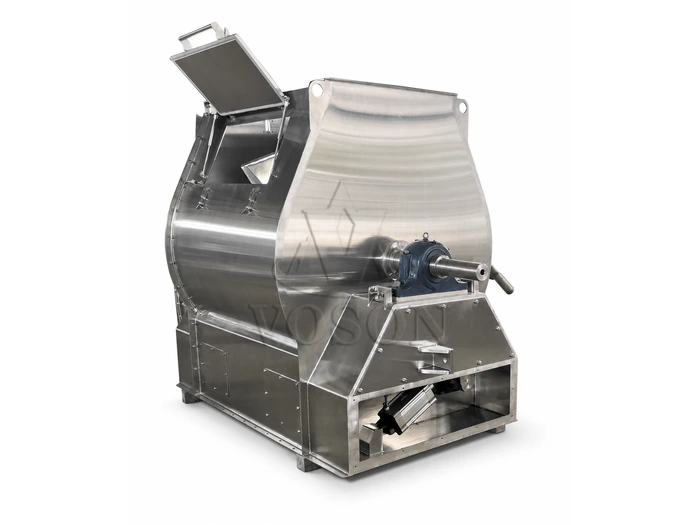
Stainless Steel Twin-Shaft Paddle Mixer
Capacity: Customized; confirmed from recipe, batch weight and working volume
Voson stainless steel twin-shaft paddle mixers support rapid batch blending and fast discharge of flour, premixes, starch and compatible dry ingredients.
The Voson Stainless Steel Twin-Shaft Paddle Mixer is designed for flour plants that need short, repeatable batch cycles. Two parallel shafts carry paddle elements through a horizontal chamber, moving ingredients between multiple zones so flour, starch, premixes and compatible dry materials can be combined before storage or packing.
The mixer is selected as part of a complete batch process. Working volume, paddle arrangement, feed sequence, mixing period and discharge opening must match the recipe, upstream weighing system and downstream receiving capacity.
Process Overview
| Batch Requirement | Available Engineering Choice |
|---|---|
| Suitable recipes | Assessed flour, starch, premixes, dry powders and compatible small granules |
| Mixing assembly | Two synchronized shafts with configured paddle positions |
| Working load | Calculated from batch weight, density and recommended filling range |
| Contact material | Stainless steel grade, finish and scope specified for the project |
| Ingredient feeding | Connected weighing bins, screw feeders, bag-dump station or manual ports |
| Emptying method | Large lower discharge adapted to a hopper or conveyor |
| Batch control | Recipe timer, sequence interlocks and optional variable-speed operation |
Published chamber volume is not the same as usable batch capacity. The actual load depends on how much space the formulation occupies and whether the selected fill level lets the paddles create the intended movement.
Designing the Total Batch Cycle
A fast mixer does not automatically create a fast production line. Total cycle time includes every stage from ingredient preparation to vessel emptying.
A complete cycle typically contains:
- Confirm mixer and receiving hopper availability.
- Weigh the main flour and other major components.
- Add minor ingredients in the defined recipe order.
- Run the paddles for the validated blending period.
- Release the batch through the lower outlet.
- Confirm discharge completion and prepare for the next recipe.
If weighing takes longer than mixing, the mixer may wait for ingredients. If the receiving conveyor is undersized, rapid discharge cannot be used effectively. Voson therefore reviews the sequence and connected equipment instead of quoting only a nominal mixing time.
What Happens Inside the Chamber
The shafts rotate in a coordinated pattern. Paddles lift portions of the batch, direct them across the chamber and exchange material between the two shaft zones. Repeated movement through these intersecting paths promotes distribution without relying on one continuous helical flow.
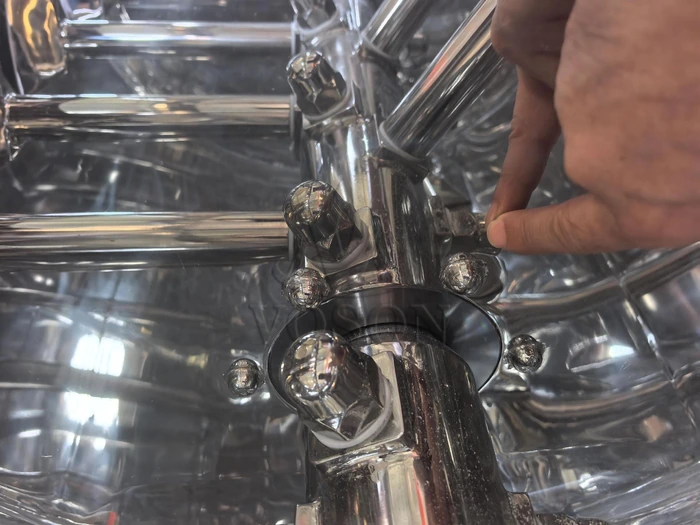
Paddle angle, spacing, shaft speed and wall clearance influence the circulation pattern. The internal detail also affects retained product and cleaning access. Component settings should be confirmed during design or commissioning rather than adjusted without considering drive load and mixing performance.
Some recipes may form a light, actively moving bed during operation. This can support rapid distribution, but terms such as “fluidized zone” do not guarantee a particular mixing time or coefficient of variation. Performance must be demonstrated using the actual formulation and an agreed sampling method.
Fast Discharge and Downstream Coordination
A wide bottom opening can empty the chamber quickly after the blending period. Short discharge time helps increase batches per hour and reduces the interval between recipes. The benefit is only realized when the receiving hopper, valve actuator and downstream conveyor can accept the released material.
The discharge transition should avoid narrow restrictions that cause bridging or backup. Level switches and interlocks can prevent opening when the next hopper is full. Valve position feedback can confirm that the mixer is sealed before the next feed sequence begins.
Batch identity must also be preserved after discharge. A blended product can segregate during a long uncontrolled fall or unsuitable conveying step, particularly when ingredient densities and particle sizes differ. The mixer outlet and following equipment should therefore be evaluated together.
Flour Plant Integration
The mixer may connect with:
- Major-ingredient bins and weighing scales.
- Micro-dosing units for low-inclusion additives.
- Dust-controlled manual addition stations.
- Feed screws or other enclosed conveyors.
- A surge hopper beneath the discharge.
- Packing, bagging or bulk-loading equipment.
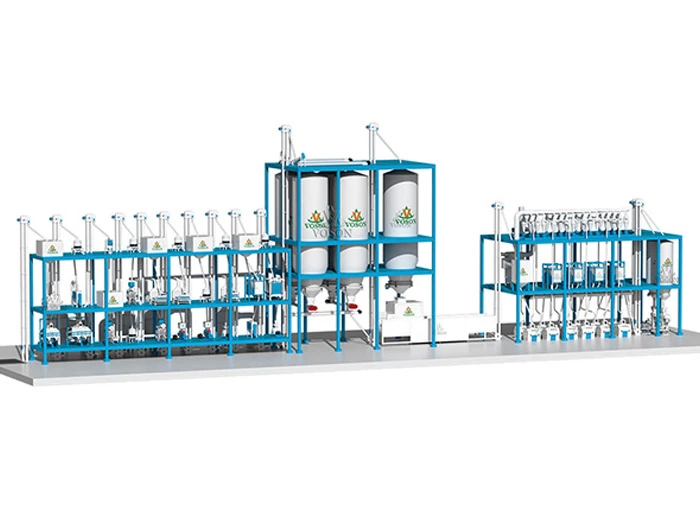
In a wheat flour milling plant, the batch system can prepare standardized flour blends or customer-specific products. A stainless steel screw conveyor may provide controlled powder transfer into a weighing bin or away from the receiving hopper.
Equipment elevations should allow gravity flow where practical while preserving cleaning and maintenance space. Structural support for a loaded mixer and hopper must be included in the plant design.
Mechanical and Hygiene Details
Chamber and Access Doors
The horizontal chamber contains the mixing load and supports the shaft assemblies. Top doors or inspection panels can be arranged for observation and cleaning, with guarding or safety switches specified for the operating method.
Shafts, Paddles and Fasteners
Paddle geometry determines how ingredients move between zones. Welded or mechanically attached components have different inspection and adjustment considerations. Fasteners inside the product area must be accessible and secured according to the chosen design.
Shaft Sealing
Seals isolate the product chamber from bearings and drive components. Flour fineness, operating pressure, cleaning method and allowable leakage influence the seal selection. Routine inspection helps identify wear before powder reaches non-product areas.
Stainless Steel Scope
Product-contact surfaces can be manufactured in a specified stainless steel grade and finish. Motors, gearboxes, bearing housings, pneumatic actuators, guards and frames are separate scope items unless full stainless construction is stated.
Control Functions
The control system can manage ingredient permission, mixing timer, motor status, discharge-valve position and downstream readiness. Recipe management, alarms and production records can be added when required by the plant automation plan.
Recipes Requiring Extra Evaluation
Twin-shaft paddle mixing can suit many dry formulations, but material behavior must be checked. Large density differences can promote segregation after mixing. Fragile inclusions can be damaged by high impact, while sticky or high-moisture ingredients may coat the paddles and chamber.
Liquid spray addition requires review of dosage, droplet distribution, nozzle position and cleaning. Abrasive components may need wear allowances or replaceable parts. Dust explosibility information is also necessary for appropriate mechanical and electrical specification.
Paddle Mixer or Ribbon Mixer?
| Production Priority | Twin-Shaft Paddle Mixer | Ribbon Mixer |
|---|---|---|
| Internal movement | Two paddle fields exchange and lift material | Helical ribbons circulate material along and across the vessel |
| Batch-cycle emphasis | Often considered for rapid circulation and large-area discharge | Often selected for general dry-powder blending duties |
| Discharge arrangement | Commonly designed with a wide lower opening | Commonly uses a bottom or side outlet |
| Recipe assessment | Particle behavior, fragility, cycle target and discharge load | Flowability, filling range, circulation and residue |
| Final decision | Based on recipe trials or verified process data | Based on recipe trials or verified process data |
A stainless steel ribbon mixer may be a straightforward choice for many powder formulations. The paddle design becomes attractive when rapid batch circulation and fast emptying are important. Neither should be selected solely from marketing claims about mixing speed.
Project Selection Worksheet
Confirmed universal models, capacities and motor powers were not supplied for this page. The following data are used to engineer a specific machine rather than to promise fixed performance.
| Customer Data | Design Decision |
|---|---|
| Full recipe and addition percentages | Material compatibility and distribution challenge |
| Target batch weight | Required working volume |
| Main ingredient bulk density | Space occupied inside the chamber |
| Required batches per hour | Allowable feeding, mixing and discharge times |
| Particle-size and density differences | Paddle arrangement and segregation assessment |
| Fragility or liquid addition | Speed, paddle geometry and optional spray equipment |
| Uniformity target and test method | Validation procedure and mixing-period confirmation |
| Cleaning and allergen requirements | Access, finish, seals and carryover controls |
| Downstream hopper capacity | Discharge opening and sequence logic |
Final motor rating, shaft speed and cycle settings are confirmed after the selected chamber and real operating duty are known.
Details Needed for a Technical Proposal
Please provide:
- Recipe components and approximate inclusion percentages.
- Desired batch weight and hourly production plan.
- Bulk density, moisture and particle range of the main materials.
- Required blend-uniformity target and sampling method, if defined.
- Weighing, dosing and manual-addition arrangements.
- Desired feeding, mixing and discharge sequence.
- Available equipment space and connection elevations.
- Downstream hopper or conveyor capacity.
- Cleaning method, product changes and allergen controls.
- Stainless steel scope, voltage and automation requirements.
Voson can then select the chamber, paddle system, drive, feed ports, discharge valve, seals, supports and controls for the complete batch line.
Frequently Asked Questions
Is a twin-shaft paddle mixer always faster than a ribbon mixer?
Not for every recipe. Paddle mixers are often considered for short cycles, but actual mixing and discharge time must be validated with the formulation, fill level and connected equipment.
How is usable batch capacity calculated?
The customer's batch weight is divided by the relevant bulk density and checked against the recommended working range of the selected chamber. Empty vessel volume should not be treated as usable capacity.
Can very small ingredients be added directly?
They may require a controlled addition point or a preliminary carrier premix. Weighing accuracy and sampling are as important as mixer action for low-inclusion components.
What supports rapid discharge?
A sufficiently large outlet, fast valve action and a receiving hopper or conveyor sized for the instantaneous flow are all required. A large valve alone does not guarantee a short discharge stage.
How often should shaft seals be inspected?
Inspection frequency depends on powder fineness, operating hours, seal type and cleaning practice. It should be included in the preventive-maintenance schedule for the selected machine.
Can the machine process mixtures containing liquid?
Limited spray addition may be possible after engineering review. High-moisture or sticky formulas can require a different internal design, drive, seals and cleaning arrangement.
Send Voson the recipe, batch target and process layout to receive a stainless steel twin-shaft paddle mixer proposal coordinated with feeding, discharge and packing equipment.
GET IN TOUCH NOW !
YOUR PRIVACY IS IMPORTANT TO US AND YOUR INFORMATION WILL BE WELL PROTECTED!